


Techniques a yoga teacher should avoid teaching in a class with students who have pre-disposed sexual related trauma
Updated: Dec 6, 2025
Introduction
Yoga practice has shown to be an effective interventional tool to help emotionally regulate our emotions and alleviate symptoms of stress, depression and anxiety and post-traumatic stress disorder (PTSD) from traumatic experiences (Clarke et al., 2014). Sexual related trauma can present as PTSD due an intimate act of penetration or touch, causing them to feel emotionally, cognitively and physically dysregulated (Hutchinson, 2015; Spindler, n.d). Practicing yoga has proven to beneficial for sexually abused trauma survivors and many survivors turn to yoga to reduce the body’s stress response systems to enhance self-regulation, resilience, mood and quality of life (Hutchinson, 2015; Bussing et al., 2012). However, if a yoga teacher is not aware or sensitive to emotional triggers and its possible intersection with the yogic experience, it has the potential to cause more harm than good for a student (Hutchinson, 2015; Rice, 2022). Due to many reasons such as the lack of availability of available resources, time or money for a teacher to further delve into being adequately trained as a trauma-informed yoga practitioner, this paper will provide key suggestions of the primary things to avoid when teaching a class with students who have pre-disposed sexual related trauma. This is in hope that yoga teachers can feel more confident and informed when conducting a class with this specific target group of students by being more trauma sensitive and aware, and to provide greater awareness about a student’s internal world in class.
How do we as teachers know if a student has a trauma?
There are a few tell-tale signs of a student potentially suffering from a trauma. More will be discussed about this shortly in the paper, but first and foremost, a teacher should never actively ask about a student’s trauma or its origination (Spindler, n.d.). There may be some students that may feel the need to open up in which we are capable of providing a listening ear and a supportive stance as a friend, and while others may manifest their difficulties throughout the practice. Some signs may include:
- Poor eye contact with the teacher, eyes are cast downwards
- Involuntary flinching when teacher approaches the student
- Responding very poorly to physical adjustments (if incorporated)
- Looking exhausted during or especially after the class
- Connects poorly with other students
- Feeling moderately or extremely uncomfortable in savasana
- Long moments in child’s pose
- Dissociative behaviour throughout the entire class
If a student has a combination of these signs it could be an indicator that the student is experiencing some kind of internal traumas and should be approached or considered carefully when teaching the class. Specific considerations to this will be discussed in the following key areas:
1. Scope of practice
2. Avoid physical assists
3. Avoid use of straps
4. Language choice & guided meditations
5. Pranayama to avoid
6. Asanas to avoid
7. Avoid holding postures
8. Alternatives to savasana
9. Set and setting
Scope of practice
First and foremost, a teacher should never ask the student about their sexual traumas or the source of their traumas (Spindler, n.d.). Many yoga teachers aren’t trained to treat mental or medical health conditions and unless they do have the proper or correct credentials, the teacher should understand the scope of their practice especially when providing advice or treatment (Spindler, n.d.; Rice, 2022). As such, any probing questions, offering advice or treatment, not understanding correct the time or environment to be providing such elements of conversational topic, should be evaded.
Avoid physical assists
Typically in a yoga class the three main methods of assistance a teacher can provide to help guide students is verbal, physical and visual (Hutchinson, 2022). However, physical assists involving a teacher touching a student to help guide them into proper alignment should be avoided, especially in the first few sessions with the student (Hutchinson, 2022). Even with good intentions, physical assists can induce a trauma response in a trauma survivor and can take away from the present moment which is encouraged in the practice itself (Yamasaki, 2019). A student may feel uncomfortable as they may prefer not to have extra attention drawn to themselves, or experience flashbacks or intrusive thoughts related to their previous trauma (Spindler, n.d.; Yamasaki, 2019). Generally, consent needs to be obtained by the teacher for every student. Useful and sensitive techniques such as using consent cards can be placed at the top of the student’s mat to either grant or decline permission for assistance can be a way to indicate a student’s preference for adjustment, which can be changed at any moment throughout the class (Spindler, n.d.).
Avoid use of straps
However, as more sessions are taken with the student and as they begin to feel safer and more comfortable with the yoga teacher, physical adjustment can be slowly and mindfully introduced (provided there is consent). If physical adjustment is eventually introduced, a recommendation is to avoid the use of yoga straps completely. The use of straps is widely used in yoga to bridge the gap between a student’s current skills and where they would like to be, enabling students to achieve greater functional capability to participate (Gothe & Mcauley, 2016). However, in students with history of sexual trauma, straps can be a trigger for victims who have been beaten or bound (Spindler, n.d.). As a recommendation, if they are required, it can be better for the teacher to demonstrate clearly what to do with the straps at the front of the class and then give the students the option of whether or not they would like to use it for themselves (Spindler, n.d.).
Language choice & guided meditations
Yoga teachers should be mindful to use inclusive and invitatory language that encourages the student to feel empowered, to have a choice and to have agency over their practice and their body (Rice, 2022). It goes without saying that any language or choice of words during sequencing that is exclusive, commanding, or produces uncomfortable imagery should be avoided (van der Kolk, 2015 & Rice, 2022). Phrases like ‘squeeze your butt’ or ‘push your hips’ can be inflammatory or induce an uncomfortable feeling, so terms like ‘raise your hips’, ‘gently lift’, root engagement or pelvic floor can convey the same meaning, but not produce an activated response (van der Kolk, 2015 & Spindler, n.d).
In addition, guided meditations and closing the eyes down should be carefully considered. It is not uncommon to use visual imagery in a yoga class or to utilise guided meditations to help relieve stress by decreasing sympathetic nervous system activity (Solanki & Saiyad, 2020). Although, for students who have PTSD from being sexually abused, hypervigilance is a common, so asking a student to close down their eyes can trigger an anxiety response (Spindler, n.d.). Instead, cues such as ‘softly lower the gaze’, ‘calm the eyes’ or even to give the student to option to leave the eyes softly open; or whether they would like to follow or not follow the guided meditation, can be a more calming alternative (Spindler, n.d.). Teachers need to be careful of the language they use during a guided meditation, as certain images can arise which can trigger uncomfortable feelings and emotions for the student too (Howard, 2022).
Pranayama to avoid
Breathing and emotions are tightly related with reciprocal influences and its incorporation in a yoga practice for self-regulation is an important function (Boiten et al., 1994; Jindani & Khalsa, 2015; Aideyan et al., 2020). However, for a survivor of sexual trauma, drawing their attention to the breath may be a trigger and cause distress, hypervigilance, panic attacks and dissociation (Yamasaki, n.d.). There have been limited studies investigating specific breathing practices in yoga for treatment of sexual abuse survivors, the general safety of its use, and its specificity about being used with whom and under what conditions (Aideyan et al., 2020). For example, it is possible that pranayama techniques such as Kumbhaka (breath retention) and Kapalabhati can cause more harm than good. According to Yamasaki (n.d.), the breath can be linked to triggers associated with trauma such as the inability to breathe or feeling suffocated, leading to an accelerated heart rate, shortness of breath and hyperventilation. As such, teachers should be mindful not to force the student to constrict their breath or to change it in a way that does not feel safe (such as mimicking hyperventilation or suffocation) and instead to focus on breathing consciously in a comfortable or natural way (Yamasaki, n.d.).
Other pranayama or breathing techniques such as Ujjayi (‘victorious breathing’), Brahmari (‘humming bee breath’) and Nadi Shodana may be useful techniques in positively altering a survivor’s emotions and resultant feelings (Boiten et al., 1994). However again, no specific studies have been done to look at the direct correlation of these specific techniques with trauma survivors. Instead, focusing on breath-centred movement is the best recommendation (Yamasaki, n.d.; Spindler, n.d.)
Asanas to avoid
When designing a class for sexual trauma survivors it is very important to consider the types of poses you are asking an individual to put their bodies into (Emerson & Hopper, 2011; Emerson et al., 2009). Any poses that can cause pain in the body leading to memories related to traumatic experiences should be avoided (Emerson & Hopper, 2011). For example, in a study by Lachiusa (2022), it was commented how certain parts of the body can hold onto strong emotions and memories such as fear, anger and anxiety. They noticed that certain aggressive spine or hip opening asanas were more likely to bring up intense feelings (Lachiusa, 2022; Rice, 2022). Poses that are sexually suggestive as shown in Appendix 1 like happy baby (Ananda Balasana), downward facing dog (Adho Mukha Svanasana), goddess (Utkata Konasana) and garland pose (Malasana) should be avoided (Spindler, n.d.). Essentially, any posture which draws open the hips to expose the pelvic region, any heart opening asanas that may feel too exposing or any posture where one’s head is down causing limited vision, should be approached with caution or removed entirely from the class (English et al., 2022; Rice, 2022).
However the reality is, any posture or gesture has the potential to be triggering for a survivor, and should be selected carefully for the individual or group that the teacher is working with (Rice, 2022). For example, Simha Pranayama (Lion’s breath) or asking a student to clasp the hands behind the head can be problematic in students with a traumatic history of bondage during sex (Spindler, n.d.). Avoiding these postures may not be entirely possible during a class but suggestions like including them later in a class, once a degree of trust has been established, can help with its integration into the practice (Spindler, n.d.).
When certain postures have the potential to invite uncomfortable feelings of being too exposed (such as in downward facing dog or in forward fold/ halfway lift), it is recommended to do them near a wall to protect the student’s privacy (Spindler, n.d.). As always, even in regular classes with students without sexual related trauma it is so important to offer the student alternatives or options so that they feel a sense of empowerment, control and autonomy (Emerson & Hopper, 2011; Emerson, Sharma, Chaudhry, & Turner, 2009).
Poses recommended by Rice (2022) that are generally safe to include in a class sequence are:
o Staff pose (Dandasana)
o Mountain pose (Tadasana)
o Gentle twists (i.e. Ardha Matsyendrasana)
o Warrior poses (Virabhadrasana I, II, III)
o Plank (Phalakasana)
o Most standing poses (i.e. Vrksasana)
These are shown in Appendix 2.
Appendix 1. Examples of postures to avoid in a class
Asana (Sanskrit name) | Demonstration | Comments |
Butterfly pose (Baddha Konasana) |  | Hip opener, can be vulnerable for student to hold as the legs are wide open |
Bridge (Setu Bandha Sarvangasana) |  | Deep chest opener and vulnerable position of hips |
Camel pose (Ustrasana) |  | Heart opening pose, vulnerable position to be in |
Half pigeon (Ardha Kapotasana) |  | Deep hip opening stretch. Block, blanket or bolster can be placed underneath the hips or femur to square the hips. |
Happy Baby (Ananda Balasana) |  | Deep hip opener, can be vulnerable to be in |
Downward facing dog (Adho Mukha Svanasana)  |  | Can be done with back legs facing a wall |
Table top & variations (cat/cow) |  |  Can be done with the bottom facing a wall |
Standing forward bend (Uttanasana) |  | Can be done with the back legs facing a wall, option to bend knees |
Halfway lift (Ardha Uttanasana) | 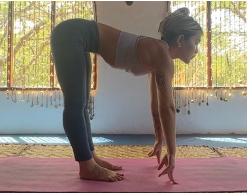 | Can be done with the back legs facing a wall |
Lizard pose (Uttana Pristhasana) |  | Variation can have back knee lifted or block under hands or elbows |
Garland pose (Malasana) |  | Deep hip opening stretch, vulnerable position of pelvis |
Wide legged forward fold (Prasarita Padottanasana) |  | Deep hip opening stretch, can be done against a wall to reduce vulnerability |
Goddess pose (Utkata Konasana) |  | Deep hip opener and vulnerable position to stay in |
Appendix 2. Examples of safe postures that can be incorporated in a class
Asana (sanskrit) | Demonstration | Comments |
Mountain pose (Tadasana) |  | Option to have eyes softly closed or lowered to the ground |
Staff pose (Dandasana) |  | Can place a bolster or blanket underneath slightly bent knees |
Seated twist (Ardha Matsyendrasana) |  | Variations can have the extended leg bent, or blanket placed underneath the lifted hip |
Extended side angle pose (Utthita Parsavakonasana) |  | Option to have lower hand on block or all the way to the ground |
Full forward bend (Paschimottanasana) | 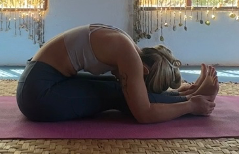 | Variations can be provided with a bolster under the knees for extra support |
Plank pose (Phalakasana) |  | Can have knees bent to the ground |
Pyramid pose (Parsvottanasana) |  | Blocks can be placed underneath one or two hands |
Tree pose (Vrksasana) |  | Foot can be placed anywhere on the standing leg except the knee |
Triangle Pose (Trikonasana) |  | Block can be placed underneath the hand towards the ground |
Warrior I, II, III (Virabhadrasana I, II, III)  |  | 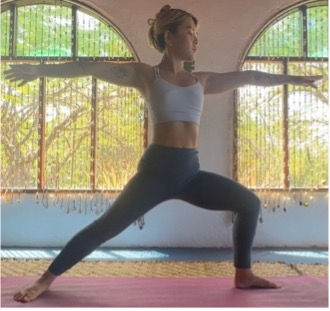 Strong and grounding postures to help focus the mind |
Alternatives to savasana
Savasana (corpse pose) is a typical final meditative posture to end most yoga classes (English et al (2022). Although, for students who have endured personal trauma, it has the potentiality to make them feel vulnerable, exposed and unsafe (English et al., 2022; Boland, 2020). This is because the pose requires the student to be laying down, often in a dark setting, with the front side exposed and the eyes closed. As discussed previously, asking an individual with PTSD and hypervigilance to close down the eyes and to be left in such a vulnerable position is not recommended. Alternatives to savasana are demonstrated in Appendix 3. These include sitting up in a seated position (i.e. in Sukhasana or Virasana) with the eyes open or laying on their side in a foetal position can be a better option to achieve a similar meditative awareness (English et al., 2022).
Appendix 3. Alternative postures to savasana
Asana (Sanskrit) | Demonstration | Comments |
Child’s pose (Balsana) |  | Variations with arms extended or towards ankles. Props can be used i.e. bolster under chest or ankles, blankets under ankles. This too, could mimic childhood sexual trauma – so considerations may be required for alterations.
|
Crocodile (Makarasana) |  | This too, could mimic feelings of being unable to breath or by having the eyes closed the student could feel unsafe. Alternatives may be required depending on the student. |
Easy seat (Sukhasana) |  | Option to sit on a block, bolster or blanket |
Infinity pose variation (Baddha Anantasana) |  | Option to have knees bent |
Avoid holding postures
Most yoga postures particularly in the case of yin yoga asks a student to stay still and to hold the posture for extended periods of time. However according to Khoudari (2021), stillness can mimic a defensive state of freeze or collapse, triggering panic or flashbacks and other symptoms of excessive nervous system arousal. Asking a student to ‘keep holding’ may remind them of language used by their perpetrator to subdue them, so it is encouraged to communicate during the class that a student has every right to come out of a posture at any time during their practice (Rice, 2022, Khoudari, 2021). As mentioned previously, if holding any posture invites any feelings of pain, the student should be encouraged to not stay in the posture but to come out of it gently (Emerson & Hopper, 2011).
Set and setting
To add to the experience of a yoga class most yoga teachers will consider incorporating scents, smells or heated environments to make a class more ‘relaxing’ for the student. However as pleasant as these smells may be for some people, certain smells can trigger involuntary recall of emotional memories (Daniels & Vermetten, 2016; Horovitz & Elgelid, 2015). In addition, in Hot Yoga or Bikram classes where the room is artificially heated between 33°C - 40°C (92°F - 105°F) that exceed a body’s normal temperature may not be the best option for students recovering from sexual trauma (Horovitz & Elgelid, 2015; Rice, 2022). Hot Yoga for example, arouses accelerated heart rates, sweat, fatigue and can cause any student to feel nausea, dizziness or disorientated states (Horovitz & Elgelid, 2015; Rice, 2022). Yoga teachers should bear in mind that a Hot Yoga or Bikram practice has a tremendous overlap with the physiological states associated with traumatic events and should avoid conducting a class in a heated environment (Horovitz & Elgelid, 2015; Rice, 2022).
Conclusion
At the end of the day there is no fool-proof formula to fully identify if a student presents with a trauma, no precise way to predict what kind of triggers may arise for a student or how to best tackle a situation should it arise in a class. Sexual abuse is very personal in both its nature and how it manifests in a survivor, and so the recovery process should just be as personal. By being aware of how trauma operates and how it can manifest differently in people, yoga teachers who have minimal trauma informed training can be better equipped with handling these sensitivities should they arise in a class.
The practice of yoga should continue to be a valid and effective approach to provide healing for survivors of sexual abuse, and hopefully with more specific research, can be integrated as a complementary and necessary technique for sexual trauma recovery. As teachers we should show ourselves the same empathy as we would a student and understand that we aren’t failures if a student is suddenly triggered in a class. As teachers, we need to ensure that the student has the support they need, which will most likely mean connecting them with an external resource, to learn from the situation, grow from it and to then release it. Hopefully from these suggestions from this paper, more teachers will understand their role as a healer, whether they know it or not, to help provide space for growth, healing and reconnection for those who have felt dysregulated from themselves for so long.
Comments